

Cycling in Girona: the complete guide
Girona is one of the best places in Europe to ride a bike. Within an hour of the old town you can climb into the volcanic hills of La Garrotxa, roll along the cliffs of the Costa Brava or lose yourself on hundreds of kilometres of gravel tracks through cork-oak forest. Add mild winters, quiet roads and a café culture built around cyclists, and it is easy to see why so many professional riders have made the city their home.
This guide brings together everything we have learned riding, living and reporting here: when to come, which roads and climbs to ride, where to find gravel, how to join a group ride and where to stay. Each section links to a deeper Nafent story if you want the full picture.
Girona at a glance
- Location: north-east Catalonia, about 100 km from Barcelona and 60 km from the French border.
- Getting there: Girona–Costa Brava airport is about 12 km from the city; the high-speed train from Barcelona Sants takes around 38 minutes.
- Best months: March to June and September to November. Winter is mild enough for training, with January highs around 13°C.
- Terrain: flat river valleys, rolling hills, climbs of up to 25 km, coastal roads and a huge gravel network.
- Signature climbs: Els Àngels, Rocacorba and the Mare de Déu del Mont.
- Best for: road cycling, gravel riding, winter training camps and cycling holidays.
Nafent Magazine
More routes, in your pocket
Our free Girona Cycling Guide brings together road and gravel routes, bike shops and coffee stops in one download. And if you want stories like this four times a year, subscribe to Nafent Magazine, our quarterly print cycling magazine.
Why Girona became a cycling capital
The professionals arrived first. From the late 1990s riders looking for a European base found what they needed here: an international airport and a high-speed rail line, a calm and affordable city, and an almost endless supply of quiet roads with every kind of terrain. Word spread through the peloton, and today dozens of professionals live and train in and around the city. We tell that story in how Girona became the road cycling capital of Europe and explain the appeal in why Girona is so famous for cycling.
What makes Girona special for the rest of us is that the infrastructure the pros created is open to everyone. Bike shops with high-end rentals, mechanics who know what a race bike needs, coffee bars that open early, and group rides you can simply turn up to.
When to cycle in Girona
You can ride in Girona all year, but the seasons feel very different. Spring, from March to June, is the classic period: green hills, flowers along the roads and comfortable temperatures. Autumn, from September to November, brings warm light, quieter roads and the grape harvest in the Empordà. Summer is hot inland, with July highs around 30°C, so start early and head for the coast or the mountains. Winter is the secret of the pros: cold mornings, but dry days with highs around 13°C that are perfect for long base miles.
For a month-by-month breakdown, read the best times of year to cycle in Girona and what to expect.
Road cycling: the routes everyone should ride
Girona sits in the middle of a cycling playground, and almost every direction offers a classic loop. A few to start with:
- The Hincapie loop: Els Àngels and Santa Pellaia, about 70 km. The ride every visitor does on day one, named after George Hincapie.
- The Costa Brava coast road: the twisting GI-682 between Sant Feliu de Guíxols and Tossa de Mar, with the sea below you on every bend. We call it the Costa Brava’s most beautiful road to ride.
- Banyoles and Rocacorba: an easy spin to the lake, with the option of one of the region’s hardest climbs on the way.
- Olot and La Garrotxa: a longer day through the volcanic landscape north-west of the city.
- The Empordà villages: flat, quiet roads to medieval villages like Peratallada, Pals and Púbol.
Distances, elevation and GPX files for ten routes, from beginner to advanced, are in our guide to cycling routes in Girona.
The climbs
Girona is not the high mountains, but the climbs around it are varied and close. Els Àngels starts on the edge of the city and climbs gently for about 11 km to the sanctuary where Salvador Dalí married Gala. Rocacorba, above Banyoles, is the local benchmark: roughly 13 km at close to 7%, with ramps of 15% near the top. The Mare de Déu del Mont is longer still, around 18 km to a sanctuary with views across the Pyrenees and the sea.
We profile the best of them, with lengths, gradients and how to combine them, in the best cycling climbs around Girona.
Gravel cycling around Girona
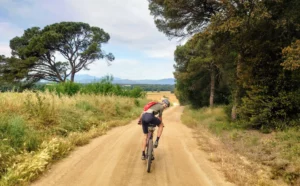
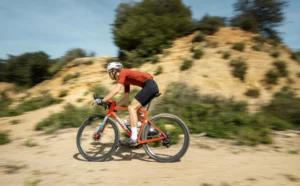
Gravel may now be Girona’s fastest-growing scene. The city is surrounded by forest tracks in Les Gavarres and the Ardenya massif, farm roads across the Empordà and old railway lines turned into greenways. The Carrilet greenway runs 54 km from Girona to Olot and another 40 km to the sea at Sant Feliu de Guíxols, and both are part of the 353 km Pirinexus loop into France. Big gravel races have followed, and so have shops and guides who specialise in off-road riding.
Start with our guide to gravel cycling in Girona (and our first take on why Girona is the best destination for gravel cycling), then go further with La Garrotxa by gravel bike and the Alt Empordà, a gravel heaven.
Group rides and cycling culture
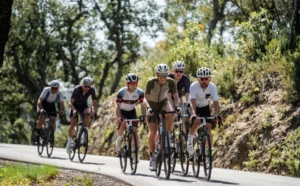
One of the best things about riding here is how easy it is to find company. Most days of the week there is a group ride leaving from a café or shop in the city, from relaxed social rides to the hard midweek bunch rides locals call the Wednesday Worlds. Our list of group rides in Girona tells you when and where they start, and what pace to expect.
Girona’s clubs and collectives are worth knowing too, from the Girona Gravel Girls to the Knuckleheads, the city’s biggest informal cycling club.
Coffee stops
Coffee is part of the ride here. In the old town you will find cafés set up by and for cyclists, and out on the roads every loop has its traditional stop: La Maglia in Platja d’Aro, Yari’s Route in Verges, Can Pericus in Banyoles or ANNNA in Sant Feliu de Guíxols. We built a set of rides around them in six perfect coffee rides from Girona.
Where to stay and how to plan your trip
Stay in or near the old town if you want to walk to the shops, cafés and group rides. Choose a farmhouse in the hills if you want to roll straight onto quiet roads, or a base on the coast if you are coming with family. Our practical guide to planning a cycling trip to Girona covers getting here, bringing or renting a bike and the cyclist-friendly places we have stayed in.
Events
Girona’s calendar is busy all year, from gravel races and sportives to bike festivals and pro team camps. See cycling events in Girona: what you need to know for the main dates and how to enter.
Nafent Magazine
Take Girona home
Independent cycling journalism, printed four times a year. Pick up the latest issue of Nafent Magazine, a Girona cycling poster or a full-year subscription in our shop.
Frequently asked questions
Is Girona good for beginner cyclists?
Yes. The river valleys and the Empordà plain have plenty of flat, quiet roads, and greenways such as the Carrilet are separated from traffic. Easy climbs like Els Àngels let you build up gradually.
What is the best month to cycle in Girona?
April, May, September and October offer the best mix of temperature, daylight and quiet roads. February and March are popular for training camps.
Do I need a road bike or a gravel bike in Girona?
Both work. A road bike suits the climbs and the coast road; a gravel bike opens up the forests, greenways and farm tracks. If you can only bring one, a gravel bike with fast tyres covers most of what the region offers.
Can I rent a bike in Girona?
Yes. Several shops in the city rent high-end road and gravel bikes, usually with a fitting, pedals and route suggestions included. Book ahead in spring and autumn.
How far is Girona from Barcelona?
About 100 km. The high-speed train takes around 38 minutes, and Barcelona’s airport is roughly an hour and a quarter away by car.
Want everything in your pocket? The Nafent Girona Cycling Guide collects our favourite routes, cafés and places to stay in one printed guide.
Related stories